
It Just Keeps Happening
Lies have a short life cycle in the modern media environment. But they are nonetheless effective.


It’s been a heck of a week on the internets for observers of the Israel-Hamas war. I don’t intend to write a long newsletter here, more an addendum to a previous post about how the information war was about to get a lot worse. TLDR: it has, and not because news about Israel or the IDF has proved worse; but because the media has proved more inept, gullible, and antisemitic than I would have predicted.
In that spirit, I want to offer three quick anecdotes that illustrate the dynamics of the information war, and a quick admonition. Also, there’s an unrelated announcement at the end of this email.
The first, perhaps the least significant of the three, is one example of a flood of stories over the weekend in which critics of Israel and fans of Hamas claimed that four IDF soldiers had been taken captive in Gaza.
Hostages are the most important weapon Hamas has in this war, and this announcement, which spread like wildfire on social media, would fill almost any Israeli family with dread. Every Israeli has a son, daughter, niece, nephew, or neighbor fighting in Gaza. The prospect that after October 7th, the IDF could fail so extensively as to allow another group of Israelis to be taken captive in the tunnels, would be profoundly demoralizing.
Except, the story wasn’t true. Hamas had not captured four soldiers after all. One could graciously blame reporting like that on Middle East Monitor or Drop Site News on the “fog of war,” or one could more honestly name what is going on — these outlets serve as propaganda hubs for Hamas.
Not that it matters to the hoards on TikTok or Twitter. The lie was told. It was believed. Even if only long enough to terrify a few soldier’s families.
A second story began with a headline from the BBC reading, “Israel Committing Genocide in Gaza, world’s leading experts say.” The article credited a resolution from the International Association of Genocide scholars, which stated unequivocally that Israel was committing genocide in Gaza.
One could be forgiven for assuming that the International Association of Genocide Scholars would have some creditable bona fides to back their assertion. But as Salo Aizenberg discovered, the barrier to entry to the International Association of Genocide Scholars amounts to $30 and a functional credit card.
In addition, Aizenberg did a little digging on the official roll of the AGS, discovering that Iraq — no friend of Israel — is home to 13% of the association’s 600 or so scholars. Indeed, as others who followed Aizenberg’s lead discovered, the association wasn’t working very hard to police its membership.
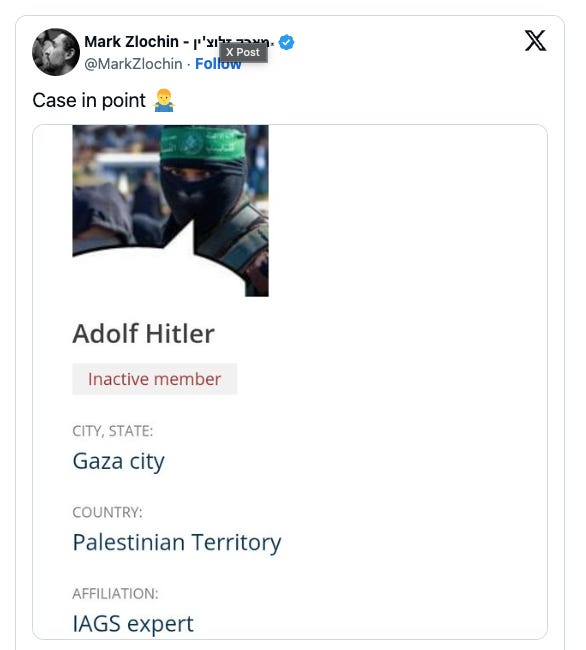
Whatever else one takes from this story, I would hope it would be a healthy amount of skepticism towards the pronouncements of fancy-sounding academic or research institutions about the status of the war in Gaza.
Finally, there’s the story of a Gazan boy reportedly murdered in cold blood at a Gaza Humanitarian Foundation food distribution location in May. This story, reported by ex-GHF whistleblower Anthony Aguilar, spread with intense virality about a month ago. Aguilar described a touching and intimate encounter with a young boy seeking food for his family, and tragically witnessing his death moments later at the hands of reckless Israelis.
It was a damning vignette of dysfunction at the GHF food distribution sites, and an indictment of a lack of discipline and morality on the part of the IDF. Except, like the other examples cited above, it simply wasn’t true. The child turns out to be very much alive, and Aguilar appears very much to be a liar.
I understand how this stuff happens. I too, a couple of weeks ago, was seduced by outrage when video circulated of an Israeli tank shelling Nassar Hospital, and then shelling it again as press and aid workers rushed to the scene. Many on social media called it a “double tap” strike, like a scene in The Hunger Games where a conniving evil strikes an area to draw aid and first responders to the scene, and strikes again once they arrive. I criticized the IDF for what appeared to be reckless (at minimum) or especially cruel.
But I jumped the gun on that judgment. It turned out that Israel struck twice at Nassar — a hospital where hostages were kept and terrorists have operated throughout the war — because there were two targets: a camera Hamas was using to monitor IDF troop movements, and a sniper position. The fact that both existed inside the boundaries of a hospital is a war crime — on the part of Hamas.
It also turns out that of the dead in the aftermath, 6 of the 20 were Hamas operatives.
In other words, there was legal and moral justification for the whole series of events. The pile-on came so hard and fast, though, that the truth struggled to catch up to the falsehood, even with someone like me who is generally pro-Israel.
The takeaway from these events is pretty simple: if you think some atrocity has occurred… wait. Give it a day or two. See what unfolds. Hamas wants to convince the world of lies, but is never invested in sustaining the lie longer that a 24-hour news cycle, so the truth often presents itself, and it’s often less damning of Israel than first blush.
It shouldn’t be this hard. I agree with Haviv Rettig Gur, who has lamented the Netanyahu government’s failure to prioritize communication with English language journalists, even while I sympathize with a sentiment that must be part of the equation: if they lie about us either way, why bother informing them?
Nonetheless, it makes not only Israel’s allies’ jobs harder, it makes journalists jobs harder. Because at the end of the day, we should want more than anything else to be able to tell the truth. And when the IDF is slow, when Netanyahu worries more about his psychotic right flank than the English speaking world, and when social media algorithms thrive on amplifying ever more libelous and outrageous claims against Israel, it makes the work of people like me — who want to tell the truth first and foremost, but want to dismantle lies about Zionism with equal ferocity — much harder.
The battle is far more uphill than folks like me want to admit. But it’s the world we live in.
Quick Announcement
At the request of a couple of folks, I decided to host another Spiritual Formation Cohort this fall. I’ve done these a number of times over the years, and the group that’s forming up is exciting. From September 10-November, we’ll meet eight times to discuss cultural and spiritual formation, the role of spiritual disciplines, the difference between disillusionment and deconstruction, and the stages of the spiritual life. We’ll also talk about developing a rule of life, and I’ll end the cohort with a 1:1 with each member of the group.
There’s some more info here and anyone interested in more details, registration fees, or other questions is welcome to either DM me there or request information via email at mcospernews@gmail.com. There’s only a handful of spots left, so don’t wait!
Okay. Done being a pitch man. See you next week.